Credit Crisis Acquisitions

M&A and Debt-Market Access in Banking Crises

Lucas S. Macoris (Chamberlain Group | FGV/EAESP)
Luiz Ricardo Kabbach de Castro (Kelley School of Business, Indiana University)
Abed El Karim Farroukh (Kelley School of Business, Indiana University)

Banking Crises and the Rollover Problem

  • When a banking system is distressed, the cost of external funding rises for firms that must refinance in the near term – i.e., the credit supply channel (Holmstrom & Tirole, 1997; Bernanke & Gertler, 1989)

  • For many otherwise viable firms, the binding friction is not the absence of investment opportunities, but a lack of rollover capacity: maturing obligations must be refinanced precisely when domestic intermediaries and local capital markets are distressed

What do we know?

  1. Credit contractions depress corporate investment (Duchin, Ozbas, & Sensoy, 2010)
  2. …particularly for firms whose long-term debt matures during the shock (Almeida, Campello, Laranjeira, & Weisbenner, 2012)

\(\rightarrow\) We understand the real effects of credit contractions, but less about the organizational mechanisms through which firms restore funding when domestic refinancing capacity collapses

This paper

Research Question

Can M&A transactions act as a financing bridge that restores debt capacity for viable firms when domestic intermediation contracts?

The idea: in a crisis, an acquirer with continued access to liquidity can target economically viable but financially constrained firms whose domestic refinancing options have deteriorated

  • For the target, the deal need not reflect weak fundamentals, operating synergies, or a desire to transfer control
  • Instead, it links the firm to an entity with stronger funding relationships and access to external debt markets
  • When the acquirer is foreign or internationally connected, the deal can also ease access to deep foreign markets through bonding/certification channels (Burns, Francis, & Hasan, 2007)

\(\rightarrow\) “Credit crisis acquisitions”: transactions driven by rollover pressure rather than weak fundamentals, functioning as a bridge to debt capacity

Our Study

  • What: we examine whether M&A transactions reallocate financing capacity to firms with acute refinancing needs when domestic credit supply contracts

  • How: use systemic banking crises (Laeven & Valencia, 2018) as negative credit-supply and predetermined rollover exposure (Almeida et al., 2012) in a difference-in-differences design, linking security-level issuance data and post-deal disclosures

Main findings

  1. High-rollover firms are 14% more likely to become targets in crisis years – concentrated at crisis onset, with no pre-trends
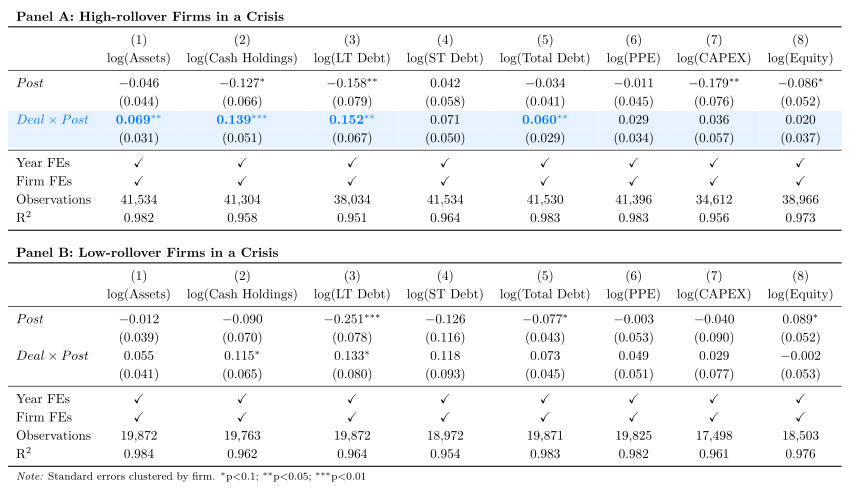
  2. They also increase assets (7%), cash (14%), and long-term debt (15%) post-deal, with no change in equity; effects concentrated in minority, cross-border, and financial-acquirer deals
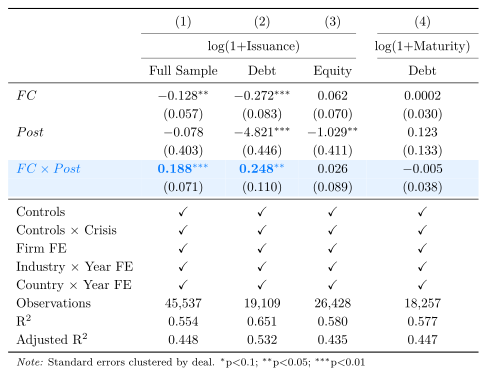
  3. Issuance is debt-driven (+25% debt issuance) and expands into deeper foreign markets
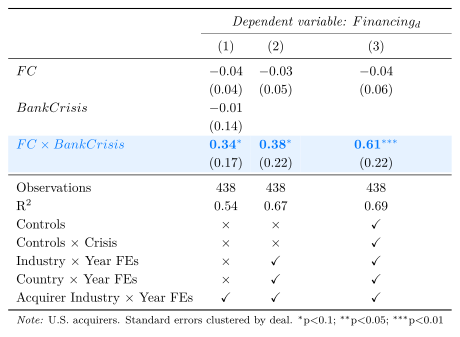
  4. Acquirer disclosures explicitly cite financing support for crisis-period, high-rollover targets

Our Contribution

We differ from existing studies on the financial motives for M&A in three respects:

  1. The friction we isolate: interacting systemic banking crises with predetermined rollover exposure isolates firms facing a sudden loss of domestic refinancing capacity – rather than generic financial constraints (Erel et al., 2015)

  2. The geography of relief: we trace where post-crisis borrowing occurs – additional debt capacity comes from deep foreign debt markets, distinguishing our mechanism from an internal-capital-market story

  3. The financing margin: a debt-centered mechanism – high-rollover targets raise debt, not equity, after crisis onset (Liao, 2014)

\(\rightarrow\) Most of this evidence is built around specific episodes (e.g., 2007–2008), and offers less direct evidence on the mechanisms firms use to offset binding refinancing needs

Data & Sample

  1. SDC Platinum (Refinitiv): completed M&A deals (1990–2019) + global debt and equity issuance data
  2. Compustat North America/Global: firm-level financials of targets and non-targets
  3. Laeven & Valencia (2018) Systemic Banking Crises Database + World Bank GFDD: country-year level
  • Targets are combined with all non-acquired Compustat firms \(\rightarrow\) unbalanced panel with 961,909 firm-year observations coming from 58,814 unique deals

  • Continuous variables winsorized by year at the \(1^{\text{st}}\) and \(99^{\text{th}}\) percentiles

Credit Supply Shock

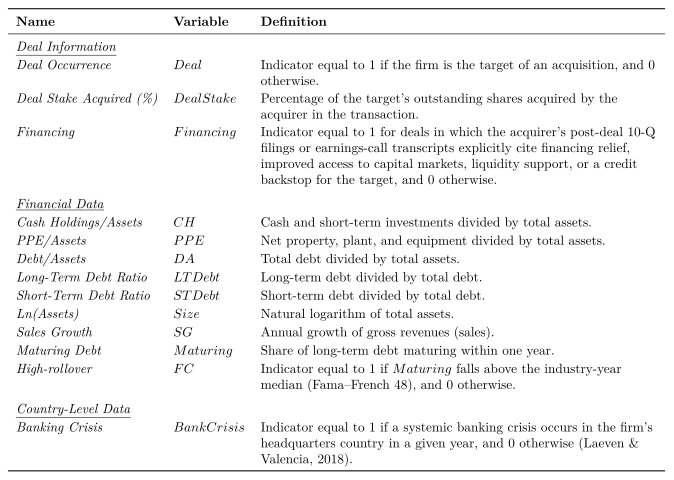
  • As in Laeven & Valencia (2018), we define \(BankCrisis_{m,t}\) as a dummy variable that assigns 1 if firm \(i\) is headquartered in a country \(m\) that experiences a systemic banking crisis in year \(t\):

    1. Significant signs of financial distress in the banking system (bank runs, losses in the banking system, and/or bank liquidations); and
    2. Sign. banking policy intervention measures in response to losses in the banking system
  • The first year that both criteria are met is the year when the crisis becomes systemic \(\rightarrow\) \(BankCrisis_{m,t}=1\)

  • The end of a crisis is the year before both real GDP growth and real credit growth are positive for at least two consecutive years \(\rightarrow\) \(BankCrisis_{m,t}=0\)

Exposure to Liquidity Shock: Rollover Pressure

  • We follow Almeida et al., 2012 and define our measure of rollover exposure based on the portion of long-term interest-bearing debt due in one year. Define \(Maturing_{i,t}\) as:

\[ \small Maturing_{i,t} = \frac{\text{Long-term debt maturing within one year}_{i,t}}{\text{Total long-term debt}_{i,t}} \]

  • When \(\small Maturing_{i,t}\) is above the Fama–French 48 industry-year median \(\rightarrow\) \(FC_{i,t}=1\)

  • Intuition: maturities are hard to adjust in the short run – the measure captures refinancing needs set before the shock, which become salient when domestic credit supply contracts

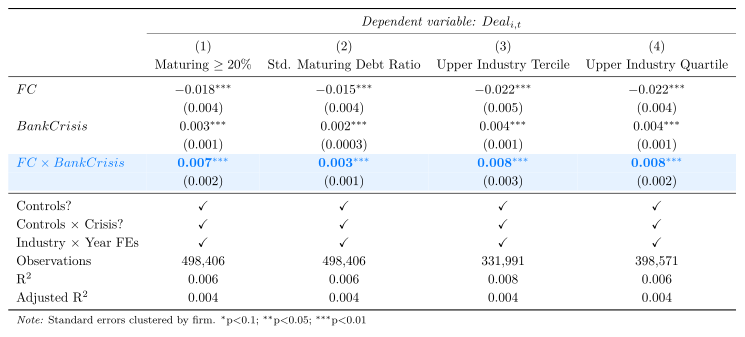
  • Robustness: fixed threshold (\(\small Maturing \geq 20\%\)), standardized continuous measure, upper industry tercile, and upper industry quartile

Empirical Design

  • To examine whether high-rollover firms are more likely to become targets when their headquarters country is hit by a banking crisis, we run:

\[ \begin{aligned} Deal_{i,t} = \; & \beta_1\times FC_{i,t} + \beta_2\times BankCrisis_{m,t} + {\color{#42affa}\beta_{DD}}\times (BankCrisis_{m,t}\times FC_{i,t}) \\ & + \gamma_1'Controls_{i,t-1} + \gamma_2'(Controls_{i,t-1}\times BankCrisis_{m,t}) + FEs + \varepsilon_{i,t} \end{aligned} \]

  • Controls: 1-year lagged Cash Holdings, Cash Flow, Leverage, and PPE (all scaled by Total Assets), Size (log assets), and Sales Growth

  • Fixed effects: firm + industry \(\times\) year + country \(\times\) year

    • Country \(\times\) year FEs absorb the crisis itself, as well as country-level demand shocks in general (macro conditions, local M&A waves, policy interventions, etc)

    • \(\beta_{DD}\) captures differential targeting of high-rollover firms within the same crisis environment

\(\rightarrow\) Under a refinancing-risk mechanism: \(\beta_{DD}>0\)

Testable Predictions

If credit crisis acquisitions substitute for impaired domestic intermediation:

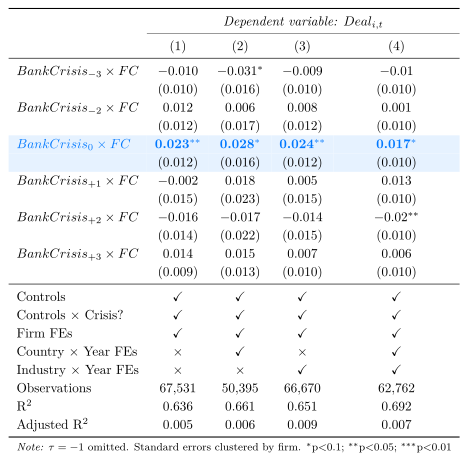
  1. Who gets targeted? The likelihood of being targeted should spike precisely at crisis onset for firms with high predetermined refinancing pressure

  2. State- and firm-contingent effects: post-deal effects should be concentrated among crisis-exposed, high-rollover targets – not a generic synergy story

  3. Financing margin: relief should show up in the ability to sustain/raise long-maturity debt, with no commensurate increase in equity

  4. Geography of capital raising: targets should expand issuance beyond disrupted domestic markets and into deeper, more liquid foreign markets

#1: High-rollover firms are more likely to become targets during banking crises
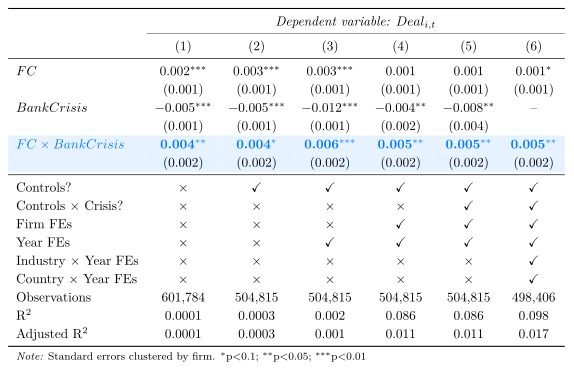
  • \(0.005/0.036 \approx\) 14% higher acquisition likelihood in crisis years (unconditional rate: 3.6%); \(FC\) alone has no bite in normal times

#2: Effects are robust to alternative measures of exposure
#3: Deal likelihood spikes at the onset of the crisis
Assessing ex-post effects

  • Do acquisitions relax financing frictions? We compare the post-deal trajectory of crisis-year targets vs. non-targets, separately for high- and low-rollover firms:

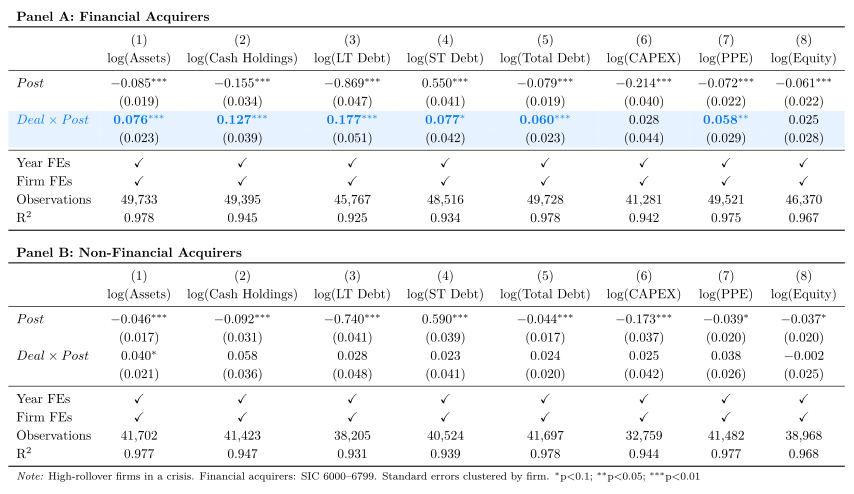
\[ \log(Y_{i,t}) = \beta_1 Deal_i + \beta_2 Post_{i,t} + {\color{#42affa}\beta_{DD}}\times(Deal_i \times Post_{i,t}) + FEs + \epsilon_{i,t} \]

  • \(Deal_i=1\) if firm \(i\) is acquired in a crisis year; firms are tracked from three years before to three years after the crisis/deal year
  • \(Post_{i,t}=1\) in the crisis/deal year and the three subsequent years
  • Firm and year fixed effects; standard errors clustered by firm

Identification logic

Generic merger synergies or operational restructuring should benefit targets regardless of their capital structure. Effects concentrated among high-rollover firms help isolating the role of the transaction in relaxing binding financing frictions.

#4: High-rollover targets preserve assets, liquidity, and long-term debt capacity
Alternative mechanisms

  • Post-deal results alone do not distinguish a credit-supply channel from standard M&A mechanisms (operational synergies, governance, managerial turnover, etc)

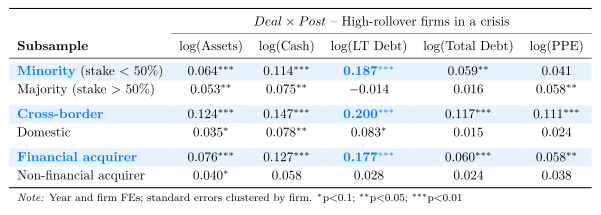
  • Auxiliary results show that (click here for full tables):

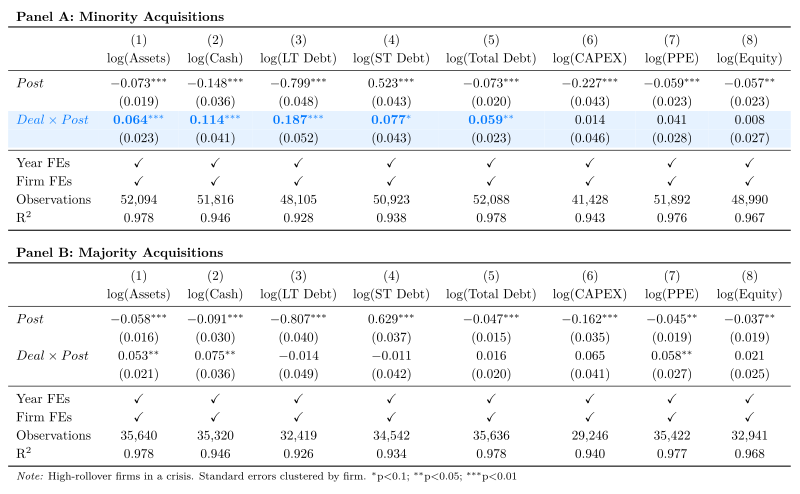
    1. Financing relief is strongest where formal control is absent
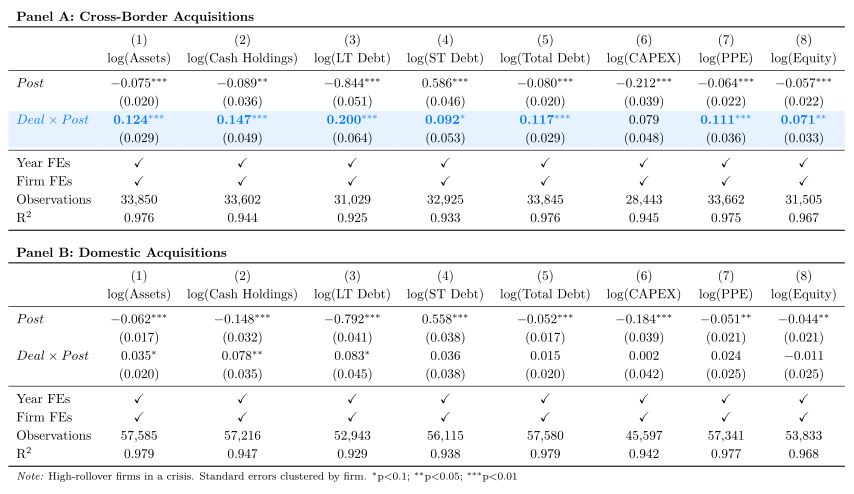
    2. Where the acquirer can connect the target to financing outside the crisis country
    3. And where the acquirer is positioned to intermediate external capital
#5: Issuance-level data for approx. 62% of targets shows that ex-post changes are driven by debt, and not equity
#6: What do acquirers say? Post-deal disclosures

  • If acquirers substitute for impaired domestic intermediation, managers should be more likely to describe crisis-period, high-rollover deals as providing financing support

Example: Deutsche Telekom \(\rightarrow\) OTE (Greece, 2011)

Deutsche Telekom acquired a 10% stake in OTE on June 6, 2011. In its Q2 2011 earnings call, the CFO noted that OTE had issued a €500m bond and had credit facilities in place, leaving “no additional refinancing needs” for 2011–2012 – while noting that Deutsche Telekom would be the “last resource” for OTE in a worst-case refinancing scenario.

  • Two-stage LLM classification (gpt-4o-mini): i) Is the deal a substantive topic? ii) Does the text tie funding, liquidity, capital-market access, or a credit backstop to the target? + keyword guardrails (e.g., revolver, refinancing, backstop)

  • \(\small Financing_d=1\) if the acquirer discusses financial support to the target in an earnings-call transcript or 10-Q within one year of the announcement (U.S. acquirers, 1995 onward)

\(\rightarrow\) Result: financing-related disclosures occur in \(\approx\) 22% of deals

#7: Crisis-period deals with high-rollover targets feature explicit financing-support language
Conclusion

We investigate whether M&A provides relief when domestic financial intermediation contracts:

  1. Acquisition targeting shifts toward high-rollover firms in banking crises: ~14% more likely to be acquired, concentrated at crisis onset, with no pre-trends

  2. The post-deal evidence points to a debt-centered financing channel: high-rollover targets increase assets, liquidity, and long-term debt, with no comparable increase in equity

  3. Issuance-level data: high-rollover targets raise ~25% more debt, expanding into large, liquid foreign markets; acquirer disclosures corroborate the financing-support interpretation

\(\rightarrow\) Credit crisis acquisitions function as a bridge to debt capacity: mergers act as substitutes for impaired domestic intermediation, with implications for how capital reaches viable firms when local credit contracts

Thank you & Questions

Appendix: Variables

Appendix: Descriptive Statistics
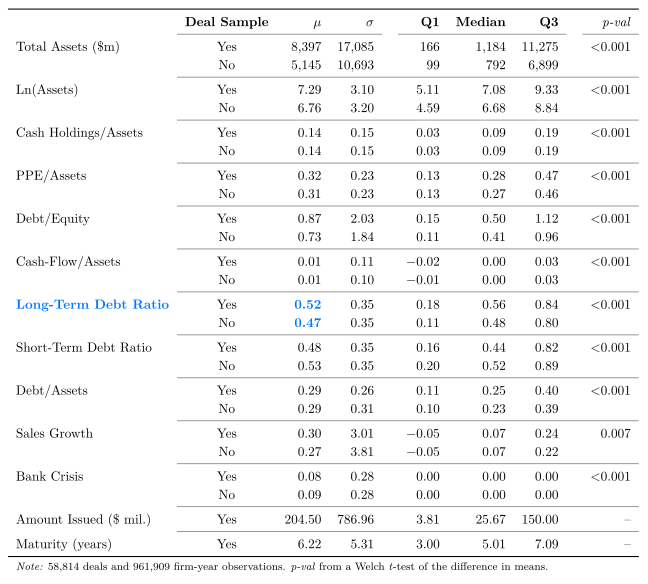
  • Targets are larger and rely more on long-term debt, but look similar in cash, capital intensity, leverage, and crisis exposure

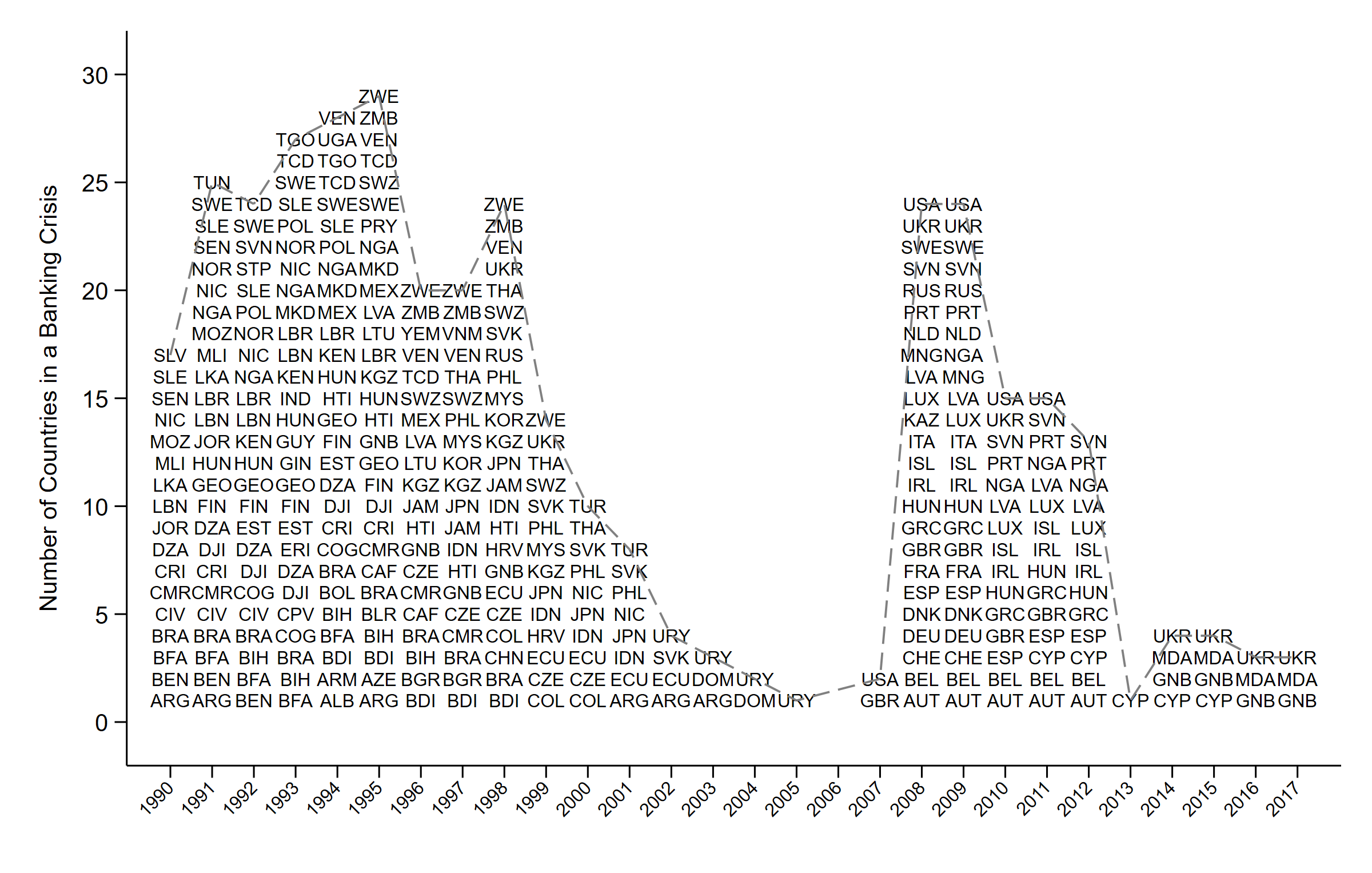
Appendix: Banking crises vary considerably in geography and timing
Back

  • Two clusters: emerging markets in the early-to-mid 1990s (Sub-Saharan Africa, Latin America, Eastern Europe) and the 2007–2012 global financial and euro-area crises \(\rightarrow\) identification does not rely on a single country-specific shock

Appendix: Minority vs. Majority acquisitions
Back

Appendix: Cross-border vs. Domestic acquisitions
Back

Appendix: Financial vs. Non-financial acquirers
Back